Pearson Edexcel · GCSE · History
Course version: 1HI0 · Version from Sept 2016
C1700–c1900: Crime and punishment in eighteenth- and nineteenth- century…
Full specification wording
Option 10: c1700–c1900: Crime and punishment in eighteenth- and nineteenth- century Britain - 2 The nature of law enforcement and punishment: The role of the authorities and local communities in law enforcement, including the work of the Fielding brothers. The development of police forces and the beginning of CID.
Law enforcement transitioned from community systems to professional forces between 1700 and 1900.
Checked against the Pearson Edexcel 1HI0 specification (opens in a new tab) on .
- Point 1 of 2
- 4 key terms
Study notes
From the checked teaching notes for this specification point.
The idea
Law enforcement transitioned from community systems to professional forces between 1700 and 1900. Initially, authorities and local communities relied on unpaid parish constables and watchmen, who were paid a small wage. A major shift occurred when Henry Fielding established the Bow Street Runners in 1749, marking the first organised detective force. His brother John Fielding later pioneered intelligence sharing by starting the 'Hue and Cry' newspaper in 1772. The development of police forces accelerated with the 1829 Metropolitan Police Act, creating London's first professional, uniformed police. The need for specialised investigation led to the beginning of the CID in 1878, separating plain-clothes detectives from regular beat officers.
What earns the marks
- Describe the traditional role of local communities and authorities in law enforcement, using unpaid parish constables and paid watchmen.
- Explain the significance of Henry Fielding in creating the Bow Street Runners (1749) and John Fielding's publication of the 'Hue and Cry' newspaper.
- Outline the development of police forces, such as the establishment of the Metropolitan Police in 1829 as the first professional, state-funded police force.
- Detail the beginning of the CID in 1878 to provide a dedicated, plain-clothes detective branch for investigating serious crimes.
Common mistakes and how to put them right
Claiming Robert Peel invented the concept of policing.
Put it right: Henry Fielding established the Bow Street Runners decades earlier, laying the groundwork for professional policing.
Attributing the 'Hue and Cry' newspaper to both Fielding brothers.
Put it right: It was specifically started by John Fielding in 1772, after Henry's death.
Assuming watchmen were unpaid volunteers.
Put it right: While parish constables were unpaid, watchmen were typically paid a small wage by the parish.
Exam tips
- Highlight the transition from local, amateur law enforcement to centralised, professional policing as a key narrative of this period.
- Use John Fielding's 'Hue and Cry' as a specific example of how information sharing improved law enforcement.
- When discussing the CID, mention the 1877 Turf Fraud scandal as the catalyst for reorganising the detective force into the CID in 1878.
Try the lesson
The start of the Option 10: c1700–c1900: Crime and punishment in eighteenth- and nineteenth- century Britain - 2 The nature of law enforcement and punishment: The role of the authorities and local communities in law enforcement, including the work of the Fielding brothers. The development of police forces and the beginning of CID. lesson, made from checked teaching notes for this specification point.
Have a go first
What was the primary purpose of the Bow Street Runners, established by Henry Fielding in 1749 and later developed by his brother John?
Listen
Law enforcement transitioned from community systems to professional forces between 1700 and 1900. Initially, authorities and local communities relied on unpaid parish constables and watchmen, who were paid a small wage. A major shift occurred when Henry Fielding established the Bow Street Runners in 1749, marking the first organised detective force. His brother John Fielding later pioneered intelligence sharing by starting the 'Hue and Cry' newspaper in 1772. The development of police forces accelerated with the 1829 Metropolitan Police Act, creating London's first professional, uniformed police. The need for specialised investigation led to the beginning of the CID in 1878, separating plain-clothes detectives from regular beat officers. A strong answer earns marks for these points. Describe the traditional role of local communities and authorities in law enforcement, using unpaid parish constables and paid watchmen. Explain the significance of Henry Fielding in creating the Bow Street Runners (1749) and John Fielding's publication of the 'Hue and Cry' newspaper. Outline the development of police forces, such as the establishment of the Metropolitan Police in 1829 as the first professional, state-funded police force. Detail the beginning of the CID in 1878 to provide a dedicated, plain-clothes detective branch for investigating serious crimes. A common slip: Claiming Robert Peel invented the concept of policing. Instead, Henry Fielding established the Bow Street Runners decades earlier, laying the groundwork for professional policing. Exam tip: Highlight the transition from local, amateur law enforcement to centralised, professional policing as a key narrative of this period.
See it
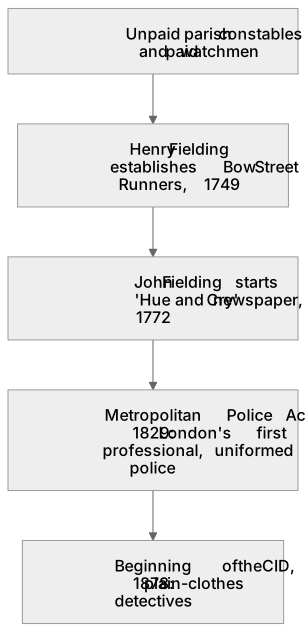
Put it in order
Put these steps in the order they happen.
- 1. Henry Fielding establishes Bow Street Runners, 1749
- 2. John Fielding starts 'Hue and Cry' newspaper, 1772
- 3. Unpaid parish constables and paid watchmen
- 4. Beginning of the CID, 1878: plain-clothes detectives
- 5. Metropolitan Police Act, 1829: London's first professional, uniformed police
Put the events in order
Put these events in the order they happened, earliest first.
- 1. The beginning of the CID separated plain-clothes detectives from beat officers
- 2. Henry Fielding established the Bow Street Runners
- 3. The Metropolitan Police Act created London's first professional, uniformed police
- 4. John Fielding started the 'Hue and Cry' newspaper
Key words
Say what each word means before you turn the card.
Bow Street Runners
Try answering aloud or in your head before turning the card.
'Hue and Cry' newspaper
Try answering aloud or in your head before turning the card.
Metropolitan Police Act
Try answering aloud or in your head before turning the card.
CID
Try answering aloud or in your head before turning the card.
See every definition
- Bow Street Runners
- The first organised detective force, established by Henry Fielding in 1749.
- 'Hue and Cry' newspaper
- Started by John Fielding in 1772 to pioneer intelligence sharing.
- Metropolitan Police Act
- The 1829 Act that created London's first professional, uniformed police.
- CID
- A dedicated, plain-clothes detective branch for investigating serious crimes, begun in 1878.
Label the diagram
Some boxes have lost their names. Pick the right name for each number.
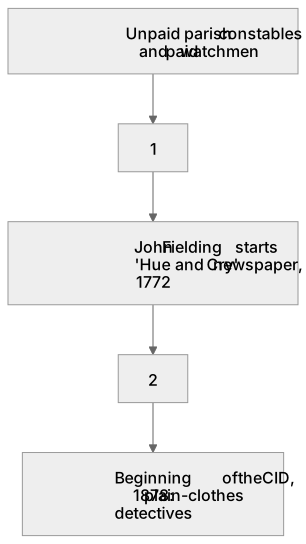
1Box 1
2Box 2
There is more to this lesson
The full lesson goes on to check your understanding and help you earn the marks. Create a free account to carry on, with your progress saved.
A week of Premium from your first lesson · Then the free plan continues · No card, no charge
Test your understanding of Option 10: c1700–c1900: Crime and punishment in eighteenth- and nineteenth- century Britain - 2 The nature of law enforcement and punishment: The role of the authorities and local communities in law enforcement, including the work of the Fielding brothers. The development of police forces and the beginning of CID.
Active recall beats re-reading. Take an instant quiz now to test what you’ve learned and lock it into long-term memory.
A week of Premium from your first lesson · Then the free plan continues · No card, no charge